
Why Do Humans Create Art?
The Source of Art in Our Minds or Brains

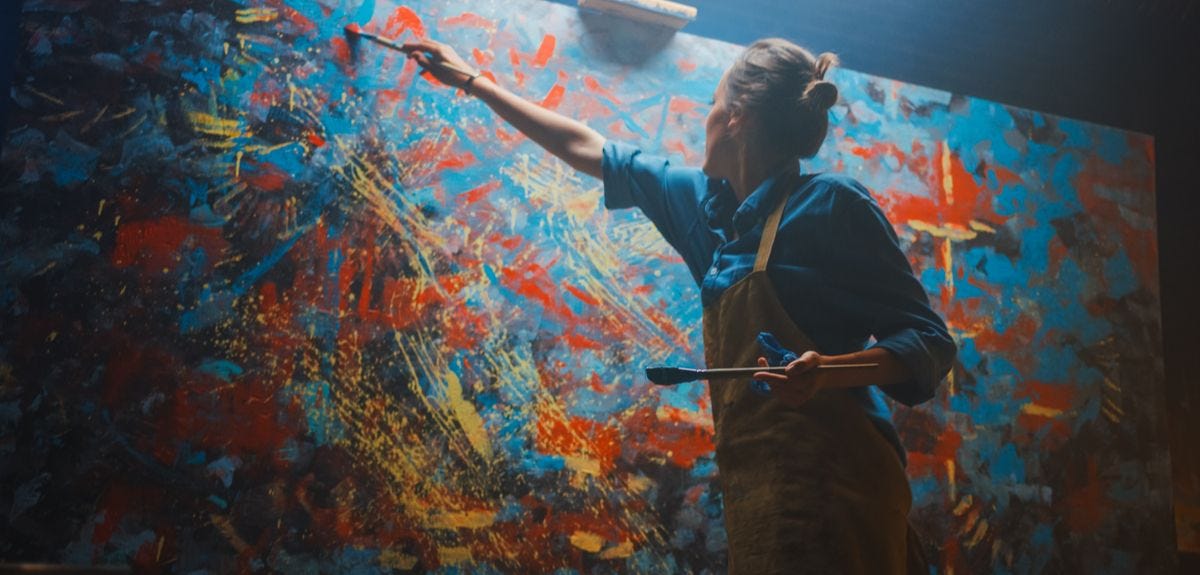
People involved in brain sciences often find themselves confronted with challenging questions. Topics such as the soul, consciousness, free will, creativity, and art frequently arise as questions. Engaging in brain sciences means attempting to understand how the highest control center, which directs human behavior and contains the programs of its response repertoire, accomplishes these tasks. While we face substantial difficulties in understanding even how we perform simple reflexes and tasks, understanding where these high human activities, which involve vague and ambiguous concepts, come from and how the brain mediates them is undoubtedly not an easy task.
One of the primary issues that people like us, who study the brain, need to ponder the most is identifying the fundamental differences that distinguish our brains from those of other living beings with which we share the world and that also have brains. If you look at "brains" in terms of material structure, you will immediately see that their structures are not very different. The only significant difference is the level of development. The human brain, in terms of structure and segmentation, is not vastly different from the brain of a dolphin, an elephant, or a monkey. However, the "small" differences probably contain the mysterious circuits and centers that can host the significant qualitative chasm between humans and these mentioned creatures.
What is Our Difference?
When we trace the history of humans back in time, the gaps and discontinuities among the remains left by humans increase as we go further back. Although we do not know exactly how long humans have been on this earth, it seems possible to talk about a history extending back 150-200 thousand years.
When we look at what is the first distinguishing feature that humans have displayed since they began to exist in this world, we do not see technological artifacts, functional designs, or other things. The first signs that remain are always related to "art."
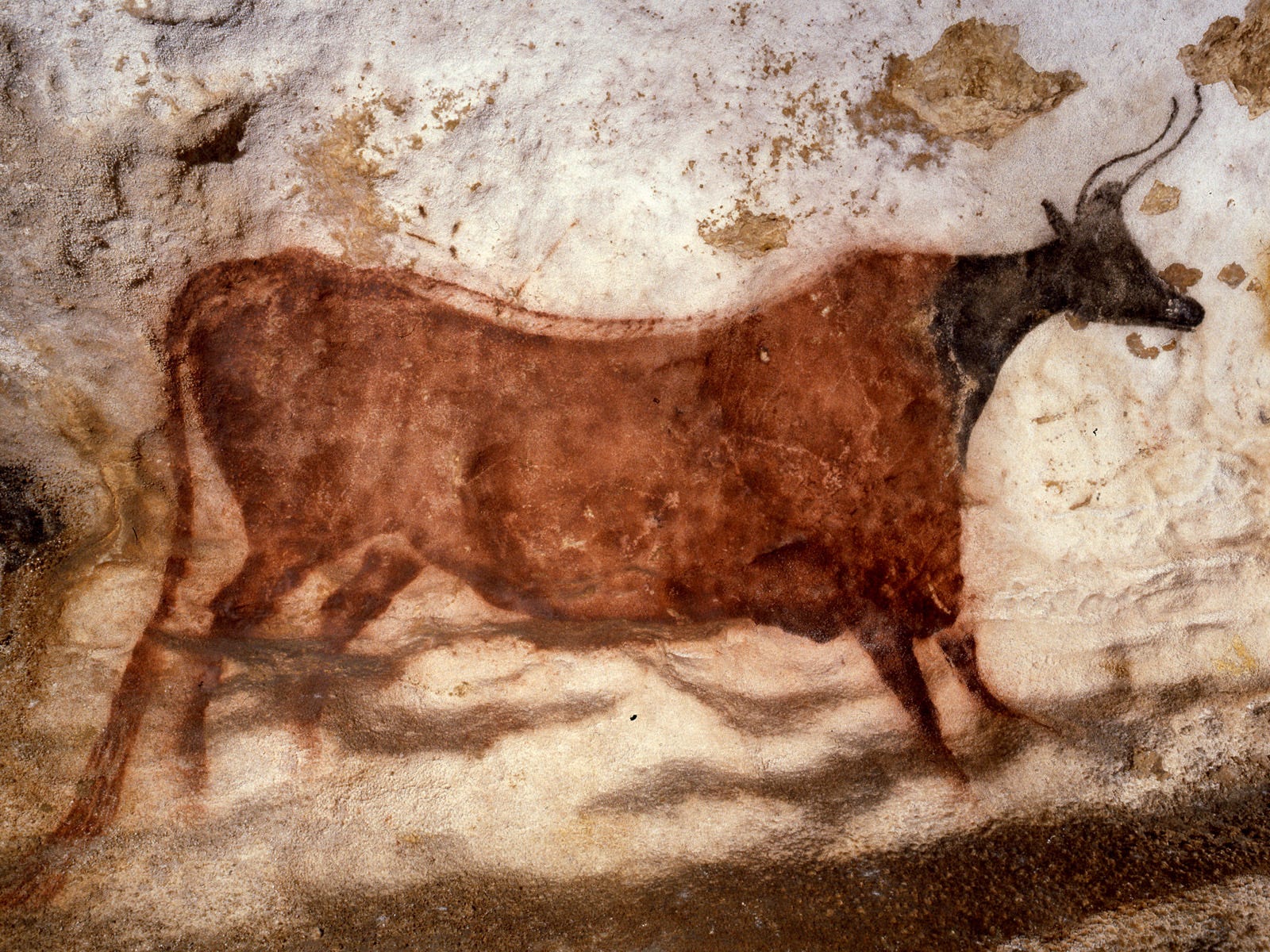
Drawings on cave walls from thousands of years ago, although their purpose is still not fully clear, cause the ability of the human brain to produce abstract works that never existed with clues from concrete reality to emerge as the first and most important distinction that separates it from animals. The cave wall paintings, which we estimate were created nearly forty thousand years ago, clearly show us how humanity, which existed in the world at a barely perceptible level, irresistibly and defiantly brought to life the profound "creative" capacity it was endowed with. So, what makes art so inseparable from humanity and what makes humans so infatuated with art? Moreover, why is art so distant from our lives today, having turned into a professional occupation, or somehow perceived that way?
The Source of Art in Our Minds or Brains
The source of art in our minds or brains is one of our most difficult questions. Today, with the technologies we have, we can image the brains of people engaged in artistic production, measure chemical levels, and observe our brains with many techniques that we could not even imagine 20-30 years ago. Despite the vast amount of information accumulating every day, we must admit that we have very little idea about art and similar "difficult" questions. However, I think the very important points we have captured whisper interesting clues about ourselves and the essence "breathed" into each of us during our creation.
The most significant difference that separates our brain from other similar creatures is the advanced development of the regions, especially in the front part. The frontal lobe, located just below our forehead, is abnormally large in us compared to all other creatures. Other parts are almost identical to what we see in other creatures. Our upper and frontal brains are so large that we have to give birth to our offspring quite early and wait for the first few years after birth for brain development. The circuits in this front part of our brain actually provide the necessary infrastructure for us to be endowed with many abilities that other creatures do not have. Our will, social skills, the ability to delay immediate gratifications for a future reward, a life bound by moral rules, speech, reasoning, and problem-solving are just a few of the many skills that occur through the complex neural computations that wander among our circuits here. When these circuits are damaged, we encounter patients who cannot exhibit most or some of these features.
Another feature provided by these frontal regions of our brain is that it allows us to exert limited control over the emotional functions carried out by the deeper areas of our brain and, more importantly, to express those unique experiences in our emotional system, that is, emotions, in various ways. Our abilities that bring to life different forms of expressions of our emotions, such as poetry, novels, painting, and music, come to life thanks to the coordination features of these advanced circuits that we have not yet solved.
Is There an Art Center in the Brain?
Coordination, or synchronization, is actually a very important concept in understanding the artistic mind. There is no special "art center" in the brain or a special "art nucleus" that endows people with artistic talent from birth. Producing artistic works seems to require the coordinated work of many different regions of the brain, and meaningful melodies, that is, various art forms, emerge from this complex orchestration. Art, rather than being a function of a specific region, appears as a process of bringing to life the tangible results of all the experiences accumulated in the brain and mind throughout life through a series of unique and unrepeatable complex processes. From this perspective, since every human possesses these circuits, we all actually have an "artist" brain at varying levels.
Understanding and interpreting art, not just producing it, also requires a brain developed at the human level. The ability to catch the same frequency with the emotions and thoughts intended to be expressed in a painting, a piece of music, or a line of poetry, to empathize with it and almost relive those feelings within oneself, constitutes an interesting feature that forms the basis of enjoying art works.
Like the personal specificity and subjectivity in the production of art, there is also a diversity as numerous as the number of people in the perception of art. Therefore, if we say that only a brain capable of making art can understand and perceive art, we will not be wrong in this respect.
What Are We Losing?
To summarize: Art is perhaps the most important feature that separates us from other creatures with brains. Since the days when humans started roaming the earth, they began to add artistic designs they produced in their minds to the surrounding world, thus changing their environment. We know that even many technological inventions first came to life as artistic drawings and ideas. However, the basic education mentality, which has become a nuisance to us as a child of the industrial revolution, has placed a lifestyle into us over centuries that always prioritizes technical and problem-solving mental attributes with economic value and remains indifferent to the high and human mental functions related to art. So much so that we have now reduced art to a mere "rich hobby" or an occasionally engaged relaxation activity beside the main (insured-salaried) profession. The cost of this is actually quite high: We have become estranged from and increasingly alienated from many high-level mental activities, which are fundamental components of our basic equipment to the extent that they could make us draw paintings on cave walls, thereby stunting and numbing them. I believe that one of the main issues underlying our fundamental problems, such as the inability to deeply understand each other, estrangement from natural processes in the world, and the inability to establish our own civilization, lies significantly in this alienation. We know that the right hemisphere of our brain is more involved in artistic and innovative events; whereas the left hemisphere is more specialized in monotonous and repetitive tasks. It seems that we have built most of our lives and the civilization we live in largely on our automatic left brain.
Of course, a system based solely on our right brain would not give us a chance to live; as living in a world where everything is uncertain, vague, subjective, and unrepeatable would be impossible. However, this current state is not good either; look again at our aesthetic level, and you will see what we have lost.
One day, while experiencing an art piece that you like, stop and think for a moment: Would it be bad if the mental skills that reflect this art also contributed a little to our ordinary daily lives? If a Rembrandt, a Dede Efendi, a J. Sebastian Bach, or a Garcia Marquez could touch our lives more, what kind of civilization would we have?
Unfortunately, we do not know the answer, but it is not too late to learn. For this, we need to quickly put those unused parts of our brain into use, without wasting any time...